كملنا - Kammelna
- 4.1
- Rating
- 1.00M
- Installs
- Free
- Price

 Analysis by App-foxy
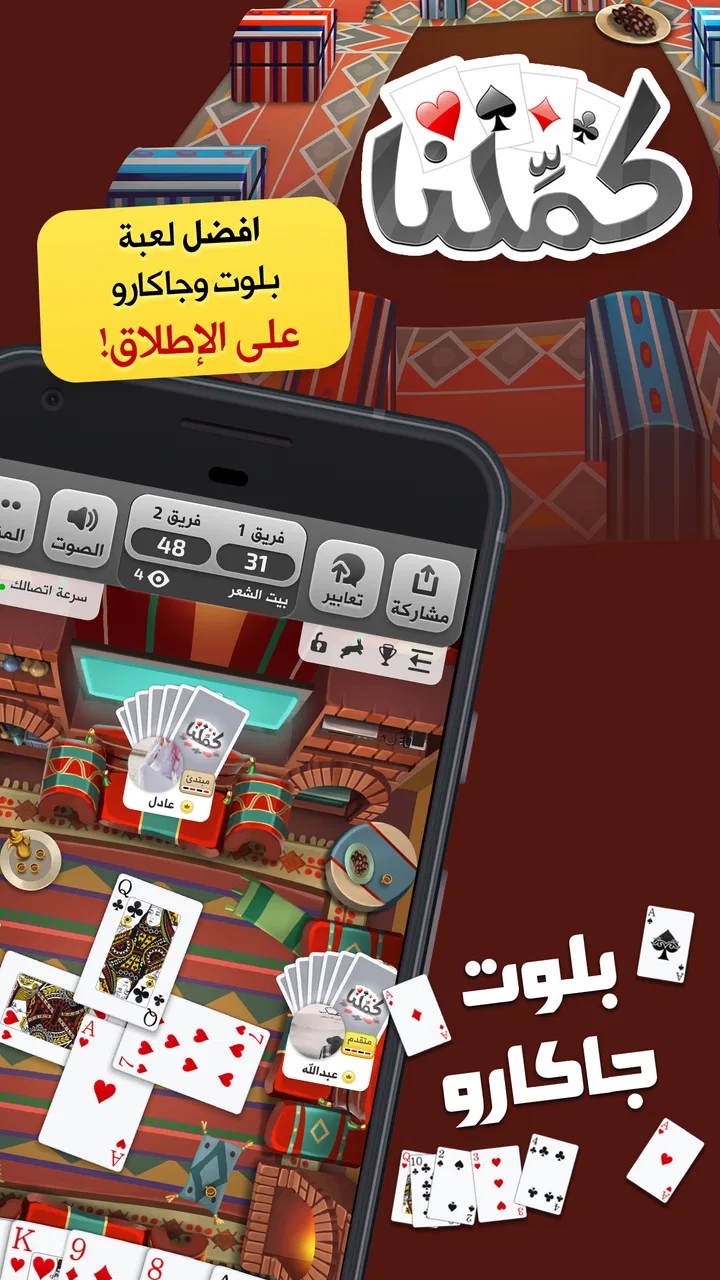
If you enjoy card games that reward memory, timing, and a little table talk, كملنا - Kammelna is an easy game to try. It is a free card game from Remal Information Technology, built around belotte and jackaroo-style play rather than the quick solo rounds found in many casual card apps. I found it most appealing when I wanted a game with familiar rules, a competitive mood, and enough room for decisions to matter.
The important thing for a first-time player is to approach it as a social, rule-focused card game instead of expecting a simple tap-and-match experience. The store summary presents it as a belotte and jackaroo game, and that description gives a better idea of its personality than the broad “card” category alone. It is aimed at people who already enjoy traditional table games or who are willing to learn through a few imperfect early rounds.
My short recommendation is this: install it if you want a free way to practise and play this particular style of card game on a phone. Skip it if you are looking for a quiet solitaire game, a story-driven card adventure, or a very gentle introduction with no rules to remember.
You May Also Like

 Blood Strike: 2.5 Anniversary
Blood Strike’s Loadouts Turn Every Drop Into a Tactical Gamble
A close look at Blood Strike’s custom loadouts: how fast access to signature weapons reshapes its battle royale rhythm, rewards preparation, and narrows the gap between fights.

 Pandora - Music & Podcasts
Pandora’s Music Is Easy to Start, but Harder to Recover
Pandora’s strength is its low-effort path from a seed to a station. Its weak spot is how much confidence it asks you to place in connection, setup, and quiet recovery.

 8 Ball Pool
 Is Built on Rivalries, Rematches, and Routine
A close look at the rivalries, rematches, shared routines, and unanswered safety questions that turn a quick pool match into a persistent mobile community.

 Samsung Music
’s Quiet Strength Is Playing What You Already Own
Its reach comes less from spectacle than from dependable access to a personal library. That simplicity is both the app’s strongest retention engine and its ceiling.

 AccuWeather: Weather Radar
AccuWeather Review: A Quick, Clear Forecast for Everyday Decisions
For everyday plans, the best forecast is the one you can understand quickly. AccuWeather makes rain timing, radar, and local conditions easy to act on, with a few trade-offs.

 Hill Climb Racing
Why Hill Climb Racing Still Turns Crashes Into One More Run
A tiny car, a bumpy hill and one more upgrade: Hill Climb Racing keeps resurfacing because its simple chaos makes every near-miss feel personal.
More From Our News Desk



What to expect when you open the game
Kammelna feels like a digital meeting point for players who already know belotte or jackaroo. That matters because these games are not based only on luck. You need to watch what has already been played, understand the value of the cards in the current situation, and decide whether to play safely or take a risk. Even when a hand goes badly, the interesting question is usually whether your decision was sensible at the time.
The game has been available since June 2015, and its continued presence is reflected in a community of more than one million installs. Its average rating sits at 4.1 from roughly 104 thousand ratings, which suggests that many players find the core experience worthwhile while also leaving room for different opinions about the interface, matchmaking, or the way individual sessions unfold.
I would not judge it after one unlucky hand. Card games can make a strong first impression in either direction: a fortunate opening can make the rules seem effortless, while a confusing deal can make a good game feel unfair. Give yourself several rounds to separate the random result of a hand from the quality of your decisions.
The game is rated Everyone, so it is presented as suitable for a broad audience. That does not mean every player will find it equally comfortable. Younger or completely new players may still need someone to explain the rules, card values, and turn flow. An experienced player can usually begin experimenting much sooner because the main challenge is decision-making, not discovering a large collection of menus.
The kind of player who will enjoy it
I see the strongest fit for players who already play belotte, jackaroo, or related traditional card games with friends and want a mobile version available between gatherings. It also suits someone who likes learning by watching patterns. If you enjoy noticing which cards have disappeared, judging what an opponent might hold, and adapting to a partner’s move, the game gives you meaningful work to do even during a short session.
It is less suitable for anyone who wants every round to be fully controlled. A card game naturally includes luck, and the app cannot remove that tension. You may make a smart choice and still lose the hand. The useful mindset is to measure progress by better reading of the table, not only by the final result.
Getting through the first setup without overthinking it
Because Kammelna is free to download, the first decision is simple: you can try the core experience without paying at the start. The current version is 3.9.5, and the listed minimum operating-system requirement is version 7.1. If your phone meets that requirement, the practical first step is to install the game, open it, and spend a moment identifying where a new round begins before worrying about advanced play.
I recommend resisting the urge to rush into a competitive mindset immediately. First, look at how the game presents the table, whose turn it is, and what information remains visible while you play. In a card game, interface clarity is part of strategy. If you miss a turn indicator or fail to notice a card that has already been played, the mistake feels like a rules problem even when it is really a reading problem.
The app includes in-app purchases ranging from $0.99 to $74.99 per item. That is worth knowing before you start, especially if the phone is shared with a child. I would begin with the free experience and decide later whether any optional purchase genuinely improves your use of the game. A purchase should not be treated as a shortcut to understanding the rules or making better decisions.
One useful setup habit is to play with your phone held in the position that gives you the clearest view of the whole table. Do not focus only on your own cards. The most valuable information is often distributed across the played cards, the current turn, and the choices made by the other side. A comfortable view reduces the chance of tapping quickly before you have read the situation.
How I would approach the first few rounds
For the first round, I would concentrate on the order of actions rather than trying to win every trick or exchange. Notice when you are expected to act, what choices are available, and what changes after a card is played. Once that rhythm becomes familiar, you can start thinking about card counting and tactical risk.
For the second or third round, choose one observation goal. You might track which high-value cards have already appeared, or you might watch how an opponent responds when a particular suit or position becomes important. Trying to track everything at once is a common beginner mistake. One reliable observation is more useful than five guesses you cannot remember.
If you are learning from scratch, playing alongside someone familiar with the game can make the first session much less frustrating. Ask them to explain why a move was sensible after the hand ends, rather than interrupting every turn. That keeps the round moving and helps you connect the result with the decision that caused it.
Finding the first meaningful success
Your first meaningful success does not have to be a dramatic win. I would define it as completing a hand while understanding why you made most of your choices. Once you can look back and say, “I played that card to protect a later option,” or “I took that risk because the important cards were probably gone,” the game has started to make sense.
A practical first target is to avoid automatic moves. Before every play, pause briefly and ask three questions: what information do I have, what might the other side be trying to do, and what option will I lose after this card leaves my hand? This small routine is more useful than memorising isolated tricks because it works across different hands.
Partner awareness is another early breakthrough. In a team-oriented card game, your best move is not always the one that makes your own hand look strongest. Sometimes preserving a card, following a pattern, or avoiding an unnecessary risk gives your partner a better chance to contribute later. You do not need perfect communication to benefit from this; simply observe whether your choices help or block the wider position.
When you lose, review the turning point instead of replaying the entire round in your head. Was the problem an early aggressive move, a failure to notice a played card, or a decision made without considering what your partner needed? This kind of short review turns a disappointing session into practice. It also prevents the common habit of blaming luck for every loss.
A realistic everyday session
Imagine you have a few minutes before leaving home or while waiting for a friend. You open Kammelna expecting one quick round. The first hand goes poorly because you spend too much attention on your own cards and miss the pattern developing on the table. Rather than quitting, you play another round with one goal: track the important cards that have already appeared.
In the next hand, you notice that a risky move is less dangerous than it first looked because several strong cards have already been used. You make the play, your partner gets room to act, and the hand develops in your favour. Even if the final score is close, that is a useful success: you changed your decision because of information, not because you tapped more quickly.
This is where the game fits everyday use well. It can occupy a short break, but it also rewards a longer session when you want to compare decisions across several hands. The trade-off is that a quick session may end before the game feels satisfying, especially if you prefer a clear beginning and ending like a puzzle level.
Common confusion that can slow down new players
The biggest source of confusion is assuming that a traditional card game can be learned from the buttons alone. A visible card may be legal to play but strategically poor. A move that looks passive may be correct because it preserves information or protects a later opportunity. If the first rounds feel opaque, the problem may be the underlying rules rather than the app itself.
Another common mistake is treating every strong card as something to use immediately. Strength is contextual. A powerful card can be wasted when played too early, while a modest card can become valuable when it removes an opponent’s option or supports your partner. I found it more helpful to think in terms of timing than simple card ranking.
New players can also misread a losing round as proof that the game is unfair. Luck is certainly part of card games, but repeated losses often reveal a pattern in how risks are chosen. If you regularly commit your best options before you know what the other side is holding, the result may have more to do with timing than with the deal.
The presence of in-app purchases can create a second kind of uncertainty. Since the game is free to start, I would not assume that spending is necessary for a first successful session. Learn the table, understand the flow, and decide whether you actually want anything optional only after you have formed an opinion about the core game.
How Kammelna compares with familiar alternatives
Compared with solitaire, Kammelna is more social and less predictable. Solitaire gives you full control over the pace and usually makes it easier to stop after a single puzzle. Kammelna is better when you want to react to other players or a changing table, but it can feel less relaxing if you dislike losing because of an opponent’s decision.
Compared with a basic offline card game, it offers the convenience of having the experience on your phone and a more connected feel. The cost is that you may need to spend more time understanding the app’s flow and adapting to the way it presents play. An offline alternative may be preferable when you want privacy, no distractions, or a game that works as a completely self-contained pastime.
Compared with a broad collection of card games, Kammelna is more focused. That focus is a strength if belotte and jackaroo are the games you actually want. It is a weakness if you install card apps mainly to move between poker, solitaire, rummy, and other formats. You are choosing a specific table-game identity rather than a large menu.
That distinction should guide your download decision. Do not choose it because it is simply labelled as a card game. Choose it because the particular style of play appeals to you, or because you want a mobile place to build familiarity with those rules.
Building better habits after the first win
Once the basic flow feels comfortable, make your practice more deliberate. Instead of playing every round with the same level of aggression, try one session where you prioritise information and another where you test carefully chosen risks. Comparing those approaches will show you which mistakes come from impatience and which come from misunderstanding the rules.
A second useful habit is to separate visible facts from guesses. You know which cards have been played; you only suspect what remains in another hand. Keeping those categories apart prevents overconfident decisions. When your guess turns out to be wrong, you can revise it without feeling that the entire game is random.
I also recommend paying attention to the tempo of the table. A quick move may communicate confidence, but it may also be routine. A pause may signal difficulty, or it may simply reflect the player’s normal pace. Treat timing as a small clue, never as proof. The strongest decisions should still come from the cards and the rules.
For players who return regularly, the real long-term value is the improvement in judgement. You begin to recognise when a hand is worth protecting, when a risk has a reasonable payoff, and when a losing position should be managed rather than rescued with a desperate play. Those lessons are more rewarding than chasing a single lucky streak.
Who should install it and who should pass
I would recommend Kammelna to someone who wants a free mobile version of belotte and jackaroo-style card play, especially if they enjoy learning through repeated hands. The broad Everyone rating makes it approachable in terms of content, while the strategic rules give it more depth than a purely casual tap game. Its community size and 4.1 average also indicate that it has attracted substantial interest from players looking for this kind of experience.
I would be more cautious about recommending it to a person who has never played a traditional card game and wants instant clarity. You can learn, but the first meaningful session may require patience or help from someone who already understands the format. I would also point a solitaire fan toward a simpler alternative if their priority is a fully predictable solo puzzle.
Players who are sensitive to optional spending should review the purchase flow carefully and keep the free starting experience as their reference point. The listed purchase range is wide enough that it is sensible to decide on a personal limit before playing, rather than making an impulse decision during an exciting session.
My final take after learning its rhythm
كملنا - Kammelna works best when you treat it as a proper table card game compressed into a phone experience. It is not at its most interesting when you rush through cards or judge it by one unlucky hand. Its appeal appears gradually, as you start reading the table, protecting future choices, and noticing how your decisions affect the whole position.
The developer, Remal Information Technology, has kept the game focused on a recognisable card-game format rather than turning it into a collection of unrelated activities. That focus will not suit everyone, but it gives the app a clear purpose. The free entry point makes trying it straightforward, while the optional purchases mean I would still play with a little spending awareness.
If you want a focused belotte and jackaroo experience and are willing to spend a few rounds learning the rhythm, this is worth installing. Start slowly, aim first to understand your decisions, and use each hand as practice in reading information rather than as a simple test of luck. That approach is what turns the first confusing session into the moment when the game finally clicks.
FAQs for كملنا - Kammelna
01What is كملنا - Kammelna and what can I use it for?
كملنا - Kammelna is a social and entertainment app designed to help users connect, communicate, and participate in shared activities through their mobile devices. Depending on the available version and region, it may include community features, interactive content, games, or group-based experiences. Before downloading, check the current store description because features and supported services can change with updates.
02Is كملنا - Kammelna free to download and use?
The application can generally be downloaded without an upfront purchase, but some features may depend on optional in-app purchases, subscriptions, advertising, or account-based services. I recommend reviewing the Google Play or App Store listing carefully before installing, especially the pricing section and payment terms. Also check whether certain premium content, extra tools, or advanced participation options require payment.
03Does كملنا - Kammelنا require an account or personal information?
Some of the app’s social or interactive functions may require registration, login, or permission to create a user profile. Depending on the sign-in method, you could be asked for information such as an email address, phone number, username, or basic profile details. Review the privacy policy and permission requests before completing registration, and avoid sharing sensitive information publicly within the app.
04Can I use كملنا - Kammelنا on Android and iPhone?
Availability depends on the official release published for your device and country. Check the verified Google Play listing for Android or the official App Store listing for iPhone and iPad before downloading. Device compatibility, operating-system requirements, language support, and regional availability may differ, so an app that works on one phone may not be supported on every older device.
05Is كملنا - Kammelنا safe for children and private conversations?
Parents should review the app’s age rating, community rules, privacy policy, and communication features before allowing children to use it. If the app includes public groups, messaging, or user-generated content, interactions may involve people users do not know. Use available privacy controls, limit profile visibility, supervise younger users, and report suspicious behavior. Do not assume every conversation or shared post is private.
Pros
- Simple interface makes it easy to browse and join available games.
- Supports social interaction with friends and other players.
- Game sessions can be started quickly without complicated setup.
- Useful for users looking for Arabic-language entertainment and community features.
- Regular activity can make the app feel engaging for frequent players.
Cons
- The number of active players may vary depending on your location and time.
- Some features may require registration or access to personal account details.
- Notifications can become distracting if several games or invitations are active.
- Performance may depend on a stable internet connection.
- The experience may feel limited if your preferred games are not supported.

كملنا - Kammelna
Gallery